Resources to Support STEM Education
Globally, there are two parallel purposes of STEM education. The first is focused on creating a pipeline of students whose educational backgrounds prepared them for a STEM-specific workforce. The second focus is on developing STEM-literate citizens necessary for success in any 21st-century profession. STEM literacy is the ability to identify and acknowledge science, technology, engineering, and mathematics concepts and processes in everyday life.
STEM literacy comes from an understanding that it takes
- a scientific approach to observe and interpret the world;
- technology to serve as a tool to solve problems or reach a goal;
- engineering to design, test, and solve a problem through the creation of products or processes; and
- mathematics to help quantify, comprehend, and evaluate the problem and solution success.
As students become STEM-literate citizens, they have the foundational content and the discipline processes to make informed decisions and to participate in public/civil discourse concerning future STEM issues and technologies.
If you have resources to include on this webpage, please email them to Anne Petersen, anne.petersen@doe.virginia.gov. We ask that all resources include alignment to Virginia Standards of Learning as part of the submitted materials.
STEM in K-12 Schools
STEM in K-12 Schools and Student Performance Expectations
Each STEM discipline has specific skills and practices that are integral to the area. The overlap of these skills and practices provides students with opportunities to engage in cross-curricular learning while applying discipline understanding to authentic engineering problems.
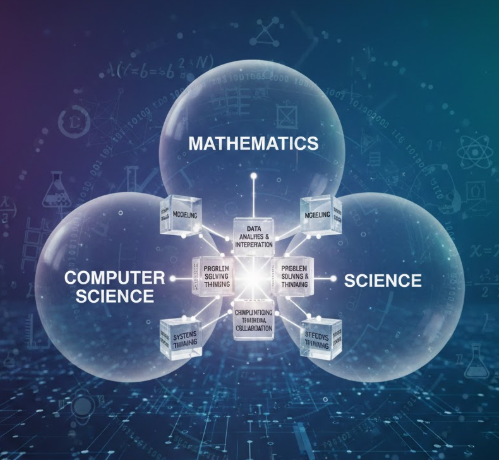
Share STEM Skills include:
- Problem Solving and Critical Thinking
- Data Collection, Analysis, Visualization, and Interpretation
- Computational Thinking
- Modeling
- Mathematical Application
- Iterative Thinking
- Collaboration
- Communication and Discourse
- Systems Thinking
The Science Standards of Learning for Virginia Public Schools identify academic content for essential components of the science curriculum at different grade levels. The content of the standards, in conjunction with effective instruction, provide a platform for creating scientifically literate students. The Science Standards of Learning reflect a vertical progression of content and practices. The Standards of Learning contain content strands or topics that progress in complexity as they are studied at various grade levels in grades K-5 and are represented indirectly throughout the middle and high school courses. These strands are:
-
- Scientific and Engineering Practices
- Force, Motion, and Energy
- Matter
- Living Systems and Processes
- Earth and Space Systems
- Earth Resources
The Science and Engineering Practices
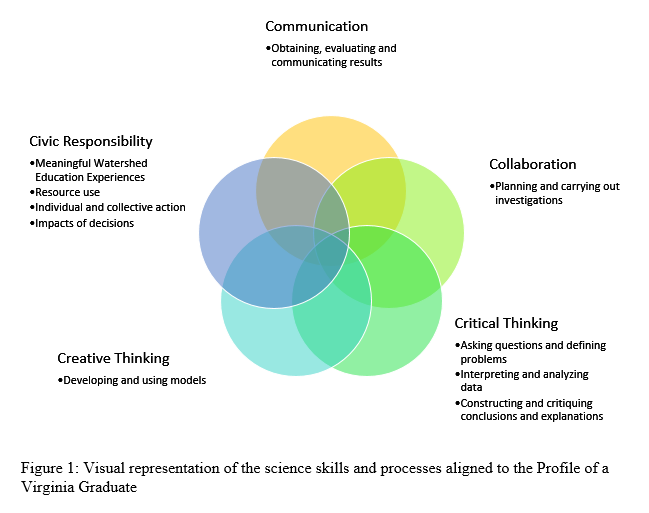
The Scientific and Engineering Practices reflected in the 2018 Science Standards of Learning describe behaviors that scientists engage in as they investigate the natural world and the practices that engineers use as they design and build models and systems.
-
Virginia’s Computer Science standards aim to raise aspirations for computational instruction to enable students to engage and thrive in a digital world. Beginning in the earliest grades and continuing through 12th grade, students must develop a foundation of computer science knowledge and learn new approaches to problem solving that harness the power of computational thinking to become both users and creators of computing technology.
Foundational principles that drive the 2024 Computer Science Standards of Learning include:
-
- Computational Thinking leverages logical reasoning and creativity to develop problem definition, component deconstruction and reconstruction, pattern identification, and systems interactions skills that develop resilient learners.
- Responsible Digital Collaboration can expedite identification of solutions in a team setting, allowing diverse perspectives, and conflicting ideas to be incorporated and reconciled more efficiently.
- Authentic Computing is paramount. Students must develop original work products, rather than relying on artificial intelligence (AI) , to produce meaningful and authentic mastery of concepts across educational disciplines.
- Artificial Intelligence (AI) Must be Used Ethically. As the availability of artificial intelligence continues to increase, it is important to instruct students on effective and appropriate AI use.
-
Elementary Engineering
Engineering design practices, built into the 2018 Science Standards of Learning and curriculum framework, use a system of problem-solving and testing to come to a conclusion. When engaging with the engineering and design process, students apply scientific, mathematics, and/or computer science concepts to solve a problem. The engineering process depends on research and experimentation and has the goal of solving a societal problem and may have multiple solutions.
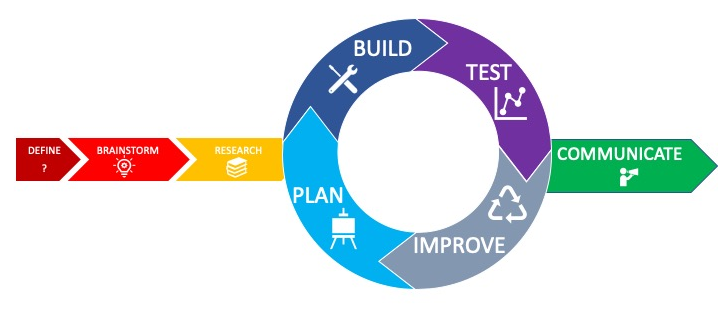
The engineering design process is iterative. Although there are steps to the process, movement between the various steps may not be sequential and may be repeated as the student or engineer develops potential solutions to the problem. The process includes:
-
- Define the problem and determine the parameters
- Brainstorm potential solutions
- Research the problem (this can be done before the brainstorm session)
- Pick one solution, plan a prototype, and determine what data to collect to determine its effectiveness
- Build the prototype
- Test the prototype
- Improve the prototype and test it again
- Communicate the results
Secondary Technology and Engineering Education
The technology and engineering education program through Career and Technical Education (CTE) provides experiences that lead to the development of technologically literate people. Consistent with their abilities, interests, and educational needs, students completing a technology education program will achieve the following goals:
- Comprehend the dynamics of broad topics of technology, including its development, impact, and potential.
- Employ the technological processes of problem solving, creating, and use the engineering design process.
- Analyze the behavior of technological systems and subsystems, including the tools, materials, processes, energy, time, information, and people involved in systems.
- Apply scientific principles, engineering concepts, and technological systems in the processes of technology.
- Discover and develop personal interests and abilities related to a wide variety of technology-oriented careers.
All competencies and curriculum frameworks for CTE programs are available from Virginia's CTE Resources Center website.
-
The 2023 Mathematics Standards of Learning were approved by the Virginia Board of Education on August 31, 2023. The 2023 Mathematics Standards of Learning represent "best in class" standards and comprise the mathematics content that teachers in Virginia are expected to teach and students are expected to learn.
Mathematics Process Goals
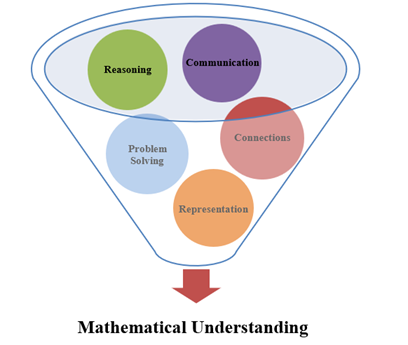
Students learn and apply the five mathematical process goals as they work to achieve the content of the Mathematics Standards. These processes support students in becoming mathematical problem solvers, communicating mathematically, reasoning mathematically, making mathematical connections, and using mathematical representations to model and interpret contextual situations. Contextual situations include real-world problems and problems that model real-world situations.
Mathematical Problem Solving
Students will apply mathematical concepts and skills and the relationships among them to solve problem situations of varying complexities. Students also will recognize and create problems from real-world data and situations within and outside mathematics and then apply appropriate strategies to determine acceptable solutions. To accomplish this goal, students will need to develop a repertoire of skills and strategies for solving a variety of problems. A major goal of the mathematics program is to help students apply mathematics concepts and skills to become mathematical problem solvers.
Mathematical Communication
Students will communicate thinking and reasoning using the language of mathematics, including specialized vocabulary and symbolic notation, to express mathematical ideas with precision. Representing, discussing, justifying, conjecturing, reading, writing, presenting, and listening to mathematics will help students clarify their thinking and deepen their understanding of the mathematics being studied. Mathematical communication becomes visible when learning involves participation in mathematical discussions.
Mathematical Reasoning
Students will recognize reasoning and proof as fundamental aspects of mathematics. Students will learn and apply inductive and deductive reasoning skills to make, test, and evaluate mathematical statements and to justify steps in mathematical procedures. Students will use logical reasoning to analyze an argument and to determine whether conclusions are valid. In addition, students will use number sense to apply proportional and spatial reasoning and to reason from a variety of representations.
Mathematical Connections
Students will build upon prior knowledge to relate concepts and procedures from different topics within mathematics and see mathematics as an integrated field of study. Through the application of content and process skills, students will make connections among different areas of mathematics and between mathematics and other disciplines, and to real-world contexts. Science and mathematics teachers and curriculum writers are encouraged to develop mathematics and science curricula that support, apply, and reinforce each other.
Mathematical Representations
Students will represent and describe mathematical ideas, generalizations, and relationships using a variety of methods. Students will understand that representations of mathematical ideas are an essential part of learning, doing, and communicating mathematics. Students should make connections among different representations – physical, visual, symbolic, verbal, and contextual – and recognize that representation is both a process and a product.
STEM Lesson Plans
These lesson plans integrate two or more STEM disciplines (Science, Computer Science, Mathematics), are aligned to the Virginia Standards of Learning, and provide opportunities for students to engage with the engineering design cycle.
-
Kindergarten Made in the Shade Lesson
Kindergarten Needs of Plants and Animals Lesson
First Grade Ramp and Roll Lesson
First Grade: Natural Resources & Conserving Paper at School
First Grade Keeping Cool at Recess Lesson
First Grade Constructing Programs, Debugging, and Looping
Grade Two Matter STEM Challenge Lesson
Grade 2 Save the Trails Lesson
Grade 2 Exploring Gravity with Slides and Marble Runs Lesson
Grade Two: I Need a New Pencil Lesson
Grade 3: May I Use the Restroom
Grade 3: Building and Using Simple Machines
Grade 3: Robot Driven Chariots
Grade 3: Conserving Water at Home
Grade 3: Schoolyard Erosion Disaster
Grade 5: In the Deep Dark Deep
Grade 5: Weather, Erosion, and Deposition...Oh, My!
Coming Soon
Coming Soon!
NASA Resource Collection: This site provides resource collections by STEM topics, including Aeronautics and Flight, Earth Science, Earth's Moon, Earth and Climate, Eclipses, Solar System and Beyond, STEM on Station, and the Sun. It also includes a section titled Outside the Classroom that includes competitive grants and partnership opportunities.
#GoOpenVA: This VDOE repository includes lessons, videos, and other media to support STEM education. Curated collections included HyperSonics STEM Curriculum, developed by the Joint Hypersonics Transition Office, Seaworth STEM Curriculum, an initiative from the United States Navy, NASA eClips, AG Cybersecurity through Virginia Tech, and the VCU STEM Project.
Project Lead the Way launched Elementary STEM Curriculum for Grades PreK-5. In these lessons, students are immersed in hands-on activities, projects, and problems that build upon each other and relate to the real world. They experience integrated learning that blends computer science, engineering, biomedical science, and more. Throughout the modules, even the youngest learners apply their math and English Language Arts (ELA) skills, learn science to standards, and adopt skills that are foundational across disciplines.
Sphero: STEM Education Resources for Every Age: The site provides lessons for elementary, middle, and high school students.
Lego Education has a resource hub that may be used to support launching a STEM/STEAM program in schools or divisions.
Try Engineering, powered by IEEE, provides STEM educational materials include videos, tutorials, lessons, activities, articles, and slides contributed by our vibrant community of teachers, volunteers, and parents. These STEM teaching resources are thoughtfully designed to support classroom instruction, enhance informal learning, and inspire hands-on exploration. By sharing a wide range of STEM outreach tools and engineering education resources, our community empowers educators and students to foster curiosity, creativity, and problem-solving skills in students. These materials help promote inclusive and engaging STEM learning experiences across diverse educational settings.
Micro:bit- This non-profit, international organization provides resources, teaching tools, and professional development to support computer science instruction.
Raspberry Pi Foundation- The Raspberry Pi Foundation is a UK-based charity with the mission to enable young people to realize their full potential through the power of computing and digital technologies. They provide high-quality training courses for educators, classroom events, and online events for teachers at no cost to educators.
Code.org- Code.org is an education innovation nonprofit dedicated to the vision that every student in every school has the opportunity to learn about artificial intelligence (AI) and computer science (CS) as part of their core K-12 education.
STEM Teaching Tools: The site offers professional development modules to support PLC work, as well as Practice Briefs that highlight specific issues that come up during STEM teaching. The site is supported by the University of Washington Institute for Science and Math Education. Check out the STEM Practice Briefs below!
- Practice Brief 7- Learning STEM Through Design: Students Benefit from Expanding What Counts as "Engineering"
- Practice Brief 19- Why should students learn to plan and carry out investigations in science and engineering
- Practice Brief 36- Failing Forward: Managing Student Frustration During Engineering Design Projects
- Practice Brief 39- How can students' everyday experiences support science learning through engineering design
- Practice Brief 45- How to focus students' engineering design projects on science learning
- Practice Brief 63- How to integrate the argumentation from evidence practice into engineering design projects
Virginia Association of Science Teachers (VAST)- This organization provides an annual professional development institute with sessions focused on science, STEM, and cross-curricular education. Paid membership includes access to publications and resources to support science instruction.
Virginia Council of Mathematics Specialists (VACMS) is a professional organization supporting the work of school-based mathematics specialists and mathematics teacher leaders.
Virginia Council of Teachers of Mathematics (VCTM)- The Virginia Council of Teachers of Mathematics is the public voice of mathematics education in Virginia, supporting teachers to ensure equitable mathematics learning at the highest quality for all students through leadership, professional development, and research.
Virginia Technology and Engineering Education Association (VTEEA)- The Virginia Technology and Engineering Education Association, an organization of technology and engineering education professionals promoting the programs of technology and engineering education and their ideas, sponsors programs and activities for students and teachers, produces publications, and continues to advance work for the profession of technology and engineering education.
CodeVA- Provides SOL-aligned lessons, professional learning opportunities, and classroom-ready materials designed to help teach computer science with confidence.